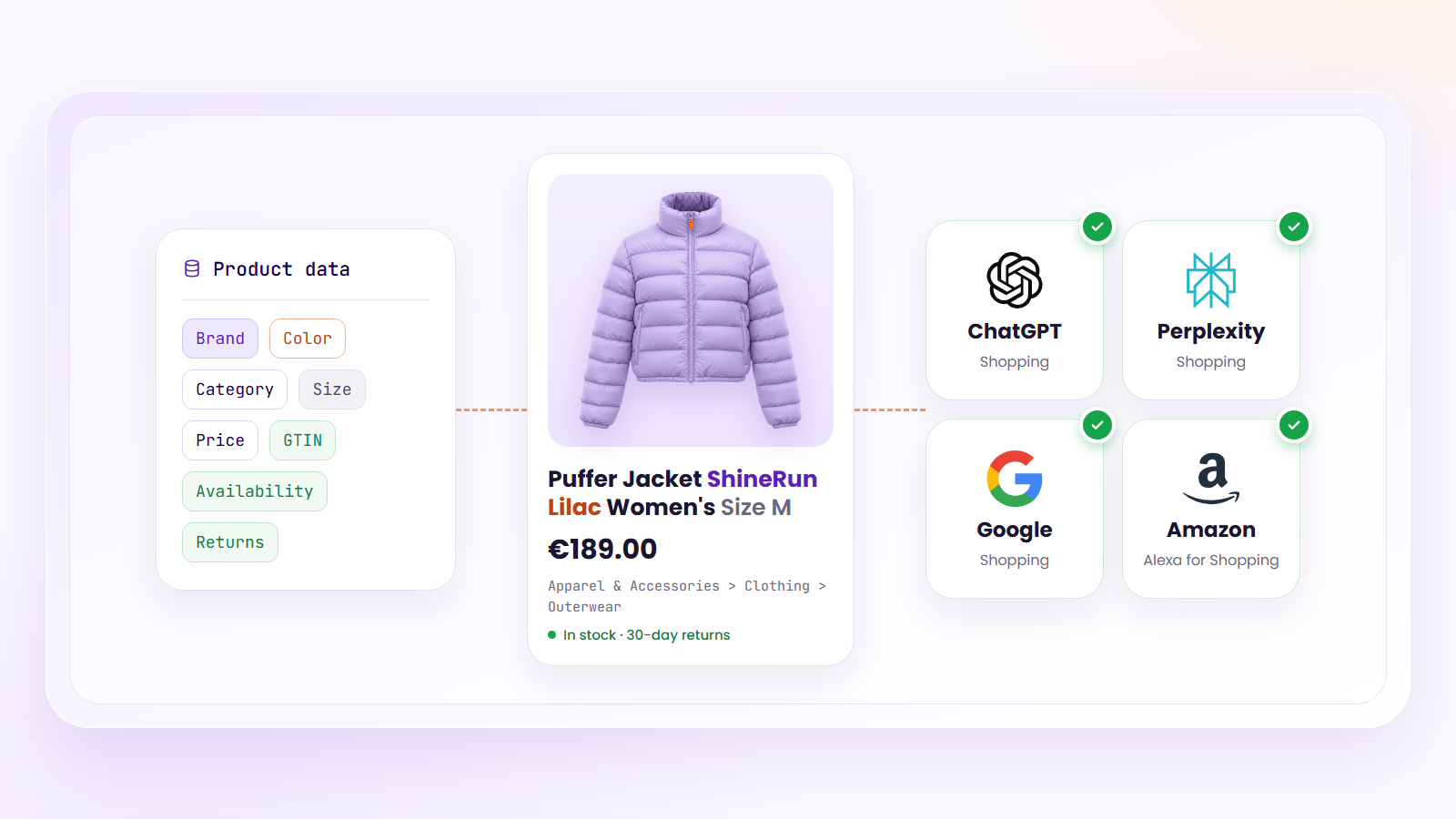
I’ve been thinking a lot about one simple question: what will e-commerce actually look like when AI stops recommending and starts buying?
Picture this. Instead of scrolling through dozens of product pages, you just tell your assistant: “Buy me a face cream under €20, for sensitive skin, delivered by Friday.” It finds the options, compares them, picks the best one, and pays. Done.
In two to three years every online store will have three customers: the human, the search engine, and the agent. The platforms that win will be the ones that treat these three equally well. In practice that means one clean, machine-readable product data layer plus a cloud checkout that agents can call directly.
Agents That Actually Buy
An AI program that acts on our behalf is called an agent. Today most agents still just advise: they suggest products and send you to the store. The next step is agents that place the order and complete the payment themselves.
This is already happening. In March 2026 Visa launched a European programme in which banks are testing payments made by AI agents. For this to work safely at scale, four things are required: clear product data, a way to verify who the agent is, secure payment methods, and rules for how agents negotiate with each other.
1. Data Agents Can Actually Use
An AI agent has no eyes. It doesn’t get impressed by beautiful photos or clever marketing copy. It reads data.
A human looks at a cream and instantly understands what it is. An agent only understands what we explicitly tell it. If the price including shipping, real-time stock status or return policy is missing or unclear, the agent treats the offer as uncertain and moves on to a store that provides clean information.
I love sailing. In navigation we talk about “Course Made Good”: the actual course the boat sailed after accounting for wind and current. That number tells you whether you will reach the destination. I borrowed the idea and call my approach Data Made Good: data that is complete, current, and readable by machines.
Large language models are excellent at conversation. To complete a purchase, however, an agent needs hard facts: what is available, what it costs right now, and when it will arrive. Without those facts, AI has nothing solid to act on.
Five major AI shopping surfaces (Universal Cart/UCP, ChatGPT Shopping/ACP, Perplexity Buy with Pro, Alexa for Shopping, and Copilot Checkout) all rely on overlapping foundations: Schema.org Product attributes, complete GTIN coverage, and high-quality Google Merchant Center feeds.
Even Gemini, when acting as an agent, has openly complained about having to “read marketing fluff written for humans.” That complaint should be a wake-up call.
So the real question is: what data, and in what form, do we need to give agents so they stop complaining and start buying?
2. How Ready Are Polish Stores? (ROI and Shine Study, September 2026)
ROI and Shine audited the product pages of Polish cosmetic brands. Two independent reviewers examined every page against one clear question: does an AI agent get everything it needs to complete a purchase?
The results were sobering. Roughly one in twenty stores is fully ready. About 40% are close to the threshold. One in four has serious gaps. Another one in four is not ready at all.
Agents can almost always identify the product. Name and price appear on 96% of pages. But the information that actually closes the sale is often missing: return policies on only 18% of pages, GTIN on 42%, customer reviews on 44%. The order is the opposite of what an agent needs.
Worse still, three out of four stores show conflicting information. We found contradictions in 74% of the shops and on almost half of all product pages. Typical examples:
- “Out of stock” next to a working “Add to cart” button
- Different prices in the structured data and on the visible page
- Shipping cost of €3.50 in the feed and “from €1.20” on the page
- Two different prices for the same product on a single page
- Instructions for a hair mask on a shampoo page, or “apply the serum” on a hand cream
- Clinical test results for a completely different product
A human can usually figure it out. An agent treats the data as unreliable and simply chooses a competitor.
What Is Essential vs. What Helps
| Technical Requirement | Specification | Notes 2026-2028 |
|---|---|---|
| Single source of truth (PIM or pipeline) | Canonical product model: SKU, GTIN/EAN, brand, MPN, category (Google taxonomy + own), attributes per category, variants, media | Most Polish stores still lack a proper PIM; a well-versioned pipeline over ERP/CSV can work |
| Attribute completeness | ≥95% fill rate on top revenue SKUs, then the rest | AI assistants have zero tolerance for gaps; optimised feeds can increase visibility 3-4x |
| GTIN on 100% of assortment | Missing GTIN = exclusion from most agent surfaces | Own-brand products without GTIN need GS1 registration: this is a cost, not an option |
| JSON-LD Product + Offer | Product, Offer, AggregateRating, Review, MerchantReturnPolicy, OfferShippingDetails, Brand, isVariantOf/hasVariant | JSON-LD accounts for 89.4% of structured data formats used by AI crawlers |
| Consistency: feed = page = checkout | Same price and stock service feeds HTML, feed, JSON-LD and the agent endpoint | Hard requirement for inclusion in Google’s agent shopping experiences |
| Freshness | Price and stock updated in minutes, not hours; webhooks preferred over nightly batches | An agent that receives a stale price will abort at checkout |
| Full Merchant Center feed | All core fields: id, title, description, price, availability, image, GTIN, brand, condition, shipping, returns | March 2026 study of 43,000 products: 83% of ChatGPT recommendations overlapped with Google Shopping’s top organic listings |
| ACP feed (OpenAI) | Includes review_count and star_rating | Keep it even after Instant Checkout ends: ChatGPT still uses it for discovery |
| Machine-oriented descriptions | Attribute-based, not marketing copy: materials, dimensions, compatibility, use cases, limitations; FAQ section per product | Agents ignore hero images and read text + attributes |
| No-JS rendering | Full product data visible with JavaScript disabled (SSR/SSG or complete HTML hydration) | Mandatory test in every audit |
| Digital Product Passport fields | Where required: identifier, composition, repairability, origin | Batteries first: mandatory from 18 February 2027; further categories via ESPR delegated acts |
Most agencies still sell “GEO” as content creation. The data and my own research show something different: for e-commerce the decisive factors are the feed and schema. Blog posts are a third-order layer. Budget should go first to the data that powers everything else, including the content.
3. Knowing Who the Agent Really Is
A store must know who is talking to it. The agent could be a trusted personal assistant, or a fraud bot or a competitor’s scraper. Every agent will need to identify itself, the digital equivalent of a courier showing ID. Cryptographic signatures will confirm that the agent comes from a trusted provider and acts on behalf of a verified person.
Privacy-preserving proofs are also emerging. An agent will be able to prove that the customer has sufficient funds and is of legal age without revealing name, address or transaction history, similar to a bouncer who only checks whether someone is over 18 and writes nothing down.
Stores will also need a proper gatekeeper. Without one, competitors could flood the site with thousands of fake agents that add products to cart and abandon them, locking inventory. Only agents that prove both identity and genuine purchase intent will be allowed in.
4. Safe Payments and Virtual Cards
The biggest practical fear is simple: what happens if the agent makes a mistake? The most sensible protection is a single-use virtual card with a hard limit (for example €35), valid for one hour and only at one merchant. Once the purchase is complete, the card stops working. Payment networks, banks and processors are already building these solutions.
A second layer can be escrow. Money first goes into a holding account and waits there, like funds held by a notary. If the agent books a trip to Málaga instead of Madeira, the customer still has time to cancel and recover the money.
5. When Agents Start Negotiating with Each Other
A customer says “kids’ bike under €180.” In a fraction of a second a digital negotiation room opens. The customer’s agent and the agents of every store that stocks a matching bike enter the room, present offers, and the customer’s agent selects the best one.
Prices will move extremely fast. A store agent that knows it is talking to another machine can drop the price by a few euros in milliseconds if its margin calculation shows that is enough to win the order. Stores that do not have accurate, real-time cost and margin data will be flying blind.
Machines negotiating at machine speed are also easy to abuse for price manipulation or fraud. That is why agent identity and access controls are not optional: they are the foundation of the entire system.
Closing Thought
Gemini has already said it out loud and quite bluntly: it has to “read marketing fluff written for humans.”
It is time to build a second path, one designed for machines and AI agents. Not more content. Structured data with clear context.
For years we have done the opposite of what agents need, because that is what Google and classic SEO taught us: we bury data inside long texts. Reversing that habit feels like trying to turn the entire internet around.
But the stores that do it first will win.
Sources
- ROI and Shine, AI search and agentic commerce readiness study of beauty e-commerce stores (100 product pages in 31 stores, two independent reviewers), September 2026
- Visa, “Visa Launches ‘Agentic Ready’ Programme to Advance Agentic Commerce in Europe”, 17 March 2026
- Google, “Google Shopping introduces Universal Cart”, 19 May 2026
- OpenAI, Agentic Commerce Protocol product feed specification (as of 30 September 2026)
- Tom Wells (Peec AI), Search Engine Land: ChatGPT sources 83% of its carousel products from Google Shopping, March 2026
- Google Merchant Center, checkout and price consistency requirements
- Regulation (EU) 2023/1542 on batteries (Article 77) and Regulation (EU) 2024/1781 on ecodesign (ESPR)