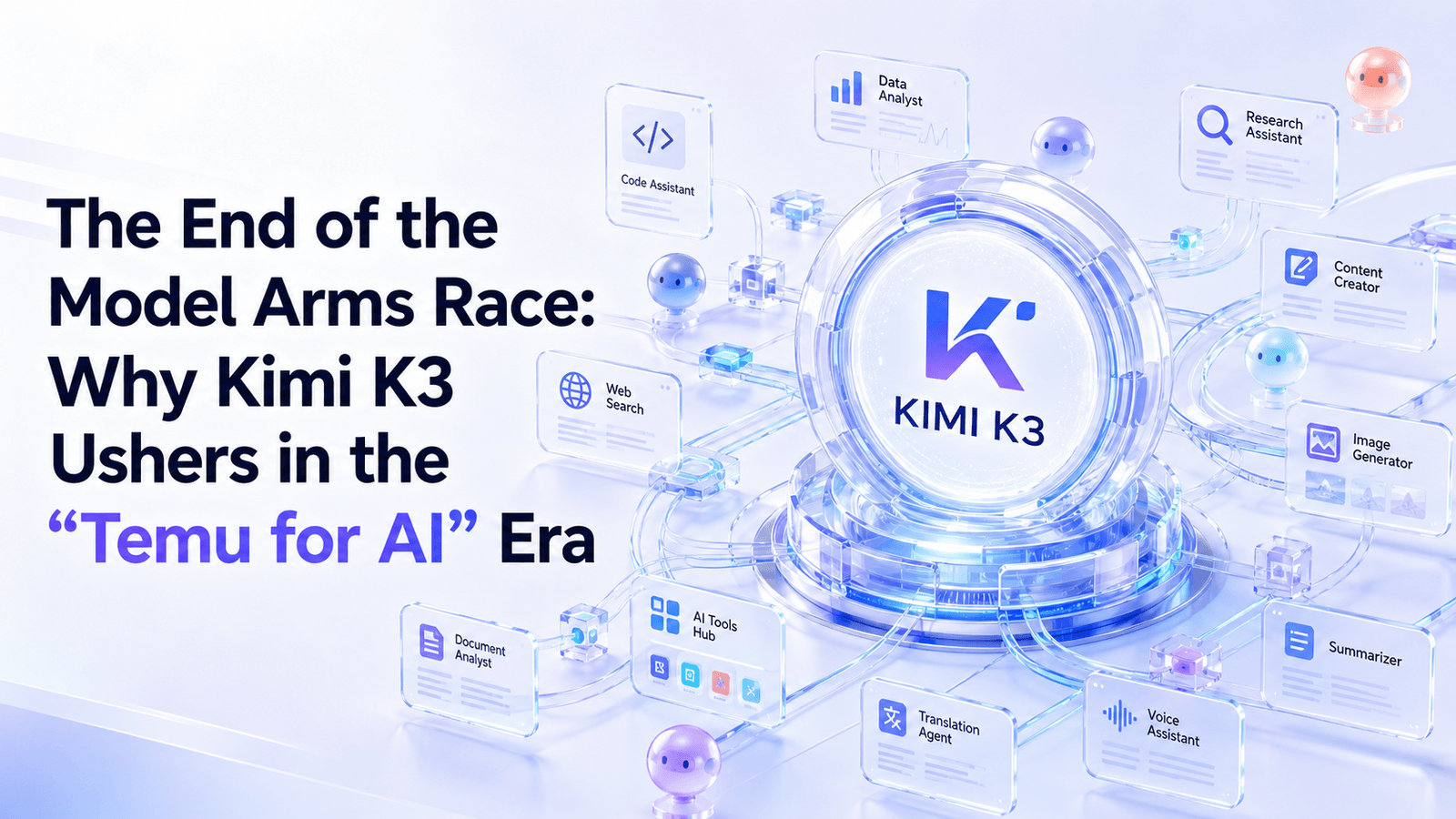
Everyone in the industry is talking about one thing right now: Kimi K3 from Moonshot AI. The reason is simple, yet completely disruptive. It delivers near-frontier performance at a price point and accessibility model that radically changes the economics of AI deployment. We have officially pushed the boundaries. The Open Source AI Era has just matured.
As a digital operator and strategist with over 15 years of experience driving technological transformation, I spent the first half of July watching a countdown clock inside my own AI stack. I observed an absolute theater of miscommunication as models like Fable 5 came and went in subscriptions.
In roughly six weeks, the market was hit with Fable 5, GPT-5.6 Sol, and now K3. But here is the catch: the last of the three arrived with public weights and a pure commodity price list.
Here is the shocking reality this summer served us: Models are becoming a commodity. The success of Kimi K3 brutally accelerates the shift from scarce, expensive frontier models to cheap, accessible intelligence. I call this the "Temu for AI" era: it is fast, efficient, "good enough" (and often exceptional) for real work, and almost free in the open-weight sense.
Anatomy of a Giant: What Actually Shipped?
Kimi K3 is a 2.8-trillion-parameter open-weight model with a one-million-token context window and native vision. It is the largest model of its kind ever released.
A dense model of this size would be practically unusable. Running every parameter on every token is the physics-and-budget wall that all trillion-scale models eventually hit.
K3 elegantly sidesteps this wall with an aggressive Mixture-of-Experts (MoE) design:
- 896 specialist sub-networks (a massive architectural footprint).
- Only 16 experts fire on any given token.
The result? You get the stored knowledge depth of a 2.8T model, but pay the inference cost of a far smaller one. This is made possible by two architectural breakthroughs, Kimi Delta Attention and Attention Residuals, published as open research before the model shipped. The full weights follow shortly on July 27, 2026, under a Modified MIT license.
The Pricing Knockout (112x Cheaper Than Anthropic)
Independent benchmarks are great (placing K3 at #4 overall on the Artificial Analysis Intelligence Index at ~57.1, competitive with top proprietary models in coding and agentic tasks). But the pricing table is what truly disrupts the market:
| Cost per 1 Million Tokens | Price (USD) |
|---|---|
| Input (cache miss) | $3.00 |
| Input (cache hit) | $0.30 |
| Output (flat rate) | $15.00 |
Let's pause at $0.30 per million input tokens on a cache hit. When you optimize your architecture and dump long contexts into the cache, this Chinese model is up to 112 times cheaper than Anthropic's frontier models for highly complex, comparable tasks.
For companies scaling AI operations, this is the difference between a project dying in the Proof-of-Concept phase and a production deployment that generates hard ROI.
The Bigger Picture: No One Has a Moat
For closed frontier labs, this is a frightening moment. Moonshot is price-dumping capability while opening the weights. This puts a hard ceiling on what closed labs can sustainably charge. Third-party hosts will quickly serve K3 (and its fine-tunes) at commodity margins.
We've seen the panic accelerate in just weeks: Anthropic extending subscriptions and bundling stronger models, OpenAI shipping GPT-5.6 Sol.
This mirrors the famous 2023 leaked Google memo: "We Have No Moat, And Neither Does OpenAI." Open-source innovation was already outpacing closed giants back then. History keeps repeating itself. Chinese labs are shipping aggressive optimizations that make processing 1M contexts highly practical and affordable. Speed of iteration wins.
My Direct Advice as an Operator
The model layer is democratizing fast. Where is the real gold? In the surrounding architecture.
- Shift Your Investment: The model layer is now the least defensible part of your tech stack. Focus your capital and engineering strictly on the Harness: agentic stacks, evaluation frameworks, memory orchestration, tool integration, and proprietary domain workflows.
- Route Smartly: Use K3 (or equivalents) for high-complexity, long-context agent work where caching shines and always-on reasoning justifies the minimal cost. Reserve lighter models for high-volume, simple tasks.
- Renegotiate Now (A Note for CFOs): AI contracts and API commitments signed at 2025 prices deserve an immediate fresh look. The negotiating table just moved significantly in your favor.
- Watch Your Compliance: For European operators, jurisdiction is a first-order variable. Moonshot's API processes data in China. However, the July 27 weights release opens the door to EU-hosted serving, instantly changing your compliance profile and making this a highly viable enterprise solution.
Get ready. The era of "good enough and almost free" has entered the boardroom. Experiment aggressively.